 Aesthetics of Inaccessibility: The Remote Place-Making
The postdoctoral research project is conducted at the Institute for East European Studies of the Freie Universität Berlin, under the Humboldt Postdoctoral Research Fellowship.
Supervisor: prof. dr. Susanne Strätling (FU Berlin).
This project explores and defines the aesthetics of inaccessibility as an artistic practice that constructs visual relationships with territories rendered inaccessible through political violence, military occupation, or war. Unlike exile aesthetics, these practices do not require lived experience of the territory. Unlike documentary art, they do not rely on direct observation. Instead, they produce place through mediation, speculation, archival fragments, testimony, and distributed visual evidence.
My object of study is not memory, but the ontology of place under conditions of inaccessibility. Access can be treated as a legal or political issue, but I suggest it also has an aesthetic dimension: political restrictions reshape not only movement but also the conditions under which a place can be visualised. This project explores, through the study of contemporary artistic practices focusing on Eastern Ukraine, how place is produced when bodily co-presence is impossible. If place is relational rather than bounded, how can artistic practice establish a relation to a territory that is physically inaccessible and perhaps never experienced firsthand?
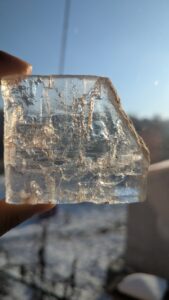
(Roksolana Dudka, Reflections, 2026. Photo credit: Roksolana Dudka)

 In Transition: Rupture and Loss in Contemporary Ukrainian Art. The Case of IZOLYATSIA
The postdoctoral research project is carried out at the Davis Center for Russian and Eurasian Studies, Harvard University, and the Institute for East European Studies of the Freie Universität Berlin.
Supervisors: prof. dr. Susanne Strätling (FU Berlin), dr Alexandra Vacroux (Harvard University).
IZOLYATSIA. Platform For Cultural Initiatives (IZO) was based at the site of a former insulation factory in Donetsk (Ukraine) and took its name from the original manufacturer. In June 2014 IZO was seized by the armed forces of the Donetsk People’s Republic, an event that forced the foundation to relocate to Kyiv. The site was turned into an illegal prison and filtration camp. In 2021 IZO’s managers decided to go back to Donbas and open its new headquarters in Soledar, a small city of the salt mines. On the 24th of February 2022, the Russian Federation started the full-scale invasion of Ukraine, leading to the almost full destruction of Soledar. I propose to analyze IZO as an institution that emerged from Donbas and was exiled from its homeplace. Recognizing the crucial role Donbas plays in (inter)national imagery of contemporary Ukraine, I aim to analyze the activity of the center which refers to its post-industrial setting in the heart of Donbas, and which mission, goals, and programming evolved drastically due to the political situation in the country. The tragedy of losing space is also a tragedy of losing identity – it is not only a place that is lost but also its origin. My research goal is to look at IZO as a place (home) that was lost multiple times. I plan to work with the concepts of home, posthome, homing, and unhoming, understanding home as a place of identity, community, and security. I am especially interested in the tension between continuity and rupture and in what lingers and what transforms.
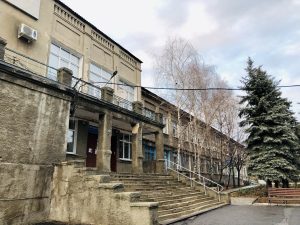
(Soledar, November 2021. Photo credit: Ewa Sułek)
Space of Transformation: Contemporary Art Centres in Kyiv. The Case of PinchukArtCentre and Mystetskyi Arsenal
The PhD thesis was carried out at Nicolaus Copernicus University in Toruń (Poland), the Faculty of Fine Arts, Cambridge Ukrainian Studies, the University of Cambridge, and Harvard University’s Harvard Ukrainian Research Institute (Fulbright Junior Research Award).
Supervisors: Prof. dr hab. Jerzy Malinowski (Nicolaus Copernicus University in Toruń), dr Katarzyna Jakubowska-Krawczyk (University of Warsaw).
Tutor: Dr Olenka Pevny (University of Cambridge).
This research examines two major art institutions founded in independent Ukraine and located in Kyiv—PinchukArtCentre and Mystetskyi Arsenal National Art and Culture Museum Complex. These institutions represent contrasting organisational models, enabling a comparative analysis of their cultural, architectural, and ideological trajectories. I approach both institutions as spaces shaped by postcolonial and post-Soviet transformation, asking how decolonisation processes have been articulated within their cultural and narrative politics and whether they actively confront the legacy of the colonial past.
My central focus is the curatorial and institutional narratives produced by these art centres and the ways in which their architectures and spatial configurations function as sites of meaning. The overarching aim of the project is to understand the nature and extent of decolonisation processes in Ukraine after 2014. Building on postcolonial scholarship, especially the work of Homi Bhabha and Leela Gandhi, I argue that the developments in contemporary Ukrainian art after 2014 constitute a postcolonial turn: a movement grounded in therapeutic engagement with history and acceptance of the past in its hybrid, non-hierarchical form. I propose that these transformations signal the first steps toward post-coloniality rather than a reversion to neo-colonial structures.
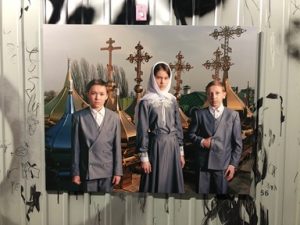
(Obabich, Mystetskyi Arsenal, 2019. Photo credit: Ewa Sułek)